

This is Part 3 of the Superfan Playbook that will teach you how to turn your audience into a real business.

The Capture Phase: Building a Foundation That Doesn’t Collapse
Part 1 gave us the importance of owning your data while Part 2 gave us a powerful case study of how to execute it. Over the next few parts of this series, we are going through the full stack - every platform, every tool, every phase of What I call the Fandom Funnel - with honest breakdowns of what each one actually does, where it fits, and when you’re ready to use it.
Today we start with the foundation. It’s not sexy or flashy, but it’s the most important. The most common mistake that I’ve seen (and made myself) is building community platforms before the community exists organically. Launching subscription tiers before you have subscribers and investing in monetization infrastructure before you have anything to monetize is a failure waiting to happen.
Today we’ll be covering the capture phase - where you’ll learn to own the relationship first. Everything else is built on top of that, or else the entire thing will collapse in front of your eyes.
Before we get started, you should ask yourself this question:
How Ready Are You?
There is a version of this playbook where you read every tool, get excited, and go build artist profiles on four platforms before you have two hundred emails. That version ends with a Discord server where nobody talks and a Vault subscription your fans didn’t ask for. The platform is not the problem. The timing is.
With a good friend of mine (Owen Hooper from Dumb Crush), we’ve been building a tool to help determine the readiness that artists are to start considering superfan infrastructure. Before you think about building out the tools, I’d encourage you to give it a shot at Sellout.fm. Throughout the next few phases of this breakdown I’ll refer back to the Sellout Fan Score to help you figure out if it’s worth investing in that part of the funnel or not. I’m not trying to sell you on anything - and the evaluation component of this will always be free, so run your metrics through there to see what score you get. The calculator measures your score through behavioural fan signals, instead of making decisions based on metrics that don’t matter — like followers or monthly listeners.
The score runs from 0 to 1,000. It measures things like how fast your tickets move, how many fans you can reach without a platform’s permission, what your audience spends per head, and whether people come back consistently. You cannot buy your way to a high score with ad spend or playlist pitching.
Think of it as a readiness check before you start spending time and money on infrastructure.
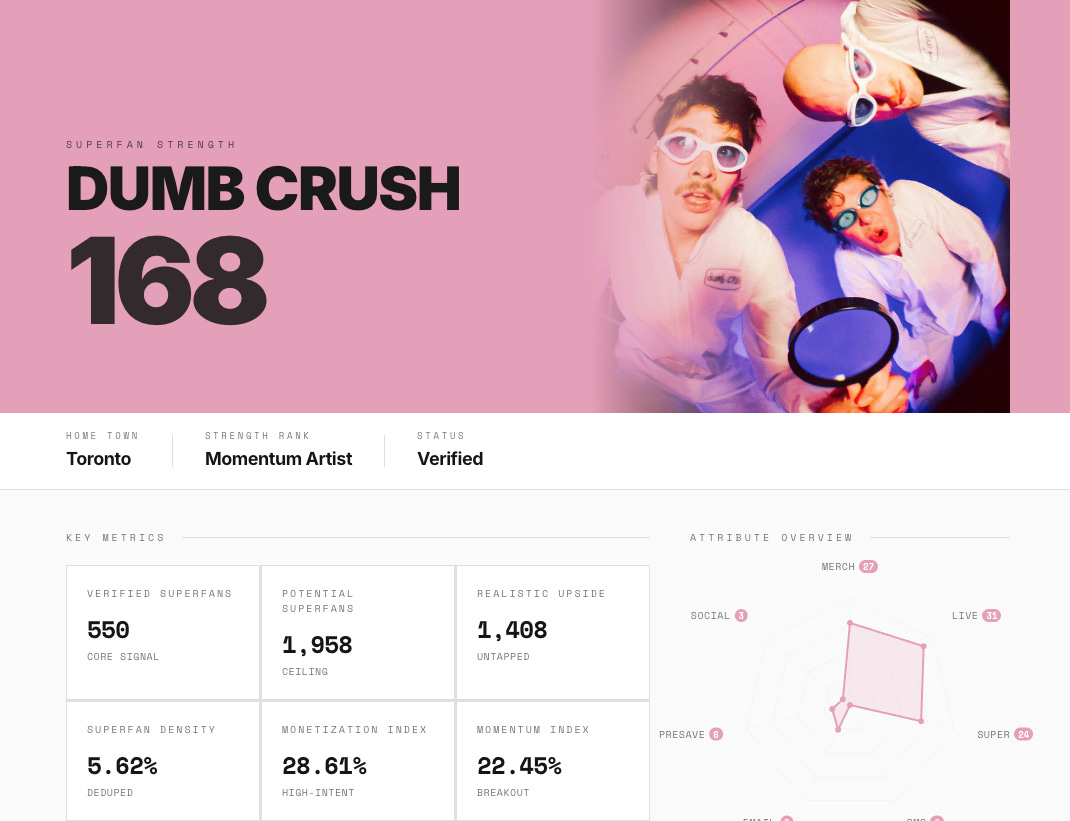
Here’s what the score tells you to do:
0–200: Your only job right now is capture. Laylo and a mailing list. That’s it. Don’t build a community platform before you have a community. Incentivize signups with real value: exclusive demos, private livestreams, giveaways, early ticket access. Every activation should come with a mechanism to collect an email or a phone number. Nothing else compounds until you have this foundation.
200–400: You have the foundation. Start building consistent fan activations with a revenue layer attached. This is where the community platforms and direct monetization tools in this guide start making sense.
500+: Without the tools we will go over later in the playbook, you are definitely leaving money on the table. The audience is there, the behavioural signals are there, and the infrastructure described in this guide is what’s missing. Build it.
Grab a notepad and write your score down as you read what follows. The tools in this particular phase are non-negotiable at every tier, but the tools in the parts after this have certain entry points. Know where you are before you decide where to start.
The Capture Problem
Capture is the act of converting a moment of fan interest into a direct relationship you own. Someone hears your song on a playlist and looks you up — that is interest. Someone signs up for your mailing list to get first access to tickets — that is a captured relationship. The difference between those two things is the difference between an audience that lives on someone else's platform and a business you actually control.
The reason most artists never build it isn’t because they’re lazy, or because they don’t understand that having an audience is important. It’s because for the last decade the music industry has trained everyone to optimize for the wrong metrics. Monthly listeners. Follower counts. View counts. Every platform that holds your most valuable audience data has a financial incentive to keep it, and they designed the experience to make you feel like those numbers mean something. They do not. A million monthly listeners with no email list is an audience you are one algorithm change away from losing entirely. Three hundred emails from fans who bought a ticket or signed up for an exclusive is a business you own.
Every tool in this part exists to close that gap. They are the part that makes everything else work.